Food Safety Level 3 (Singapore): Meaning, Structure and Workforce Requirements
Food Safety Level 3 is a supervisory-level food hygiene certification used in Singapore’s food services sector. It is designed for individuals who oversee food handling operations, ensure compliance with hygiene regulations, and manage staff in food preparation environments.
In Singapore, this qualification is commonly aligned with WSQ Food Safety Course Level 3 and is required or strongly preferred for supervisory roles in restaurants, catering businesses, and central kitchens regulated by the Singapore Food Agency (SFA). The focus is not basic food handling, but operational control of food safety systems.
It sits above entry-level food hygiene certification and is positioned for workers transitioning into team leadership or operational oversight roles in food establishments.
How Food Safety Level 3 Works
Food Safety Level 3 training operates as a competency-based certification. Learners are assessed on their ability to apply food safety principles in supervisory contexts rather than only performing individual tasks.
The structure typically includes theoretical instruction, scenario-based learning, and practical assessment. Candidates must demonstrate understanding of hygiene control systems and the ability to enforce compliance among team members.
Core operational logic:
Food safety regulations → supervisory interpretation → workplace enforcement → compliance verification
Core Framework Structure
Component | Focus Area | Workplace Function |
Food safety principles | Microbiological and contamination risks | Identify hazards in operations |
Hygiene control systems | Cleaning, sanitation, pest control | Implement standard procedures |
Supervision practices | Staff monitoring and instruction | Enforce compliance among workers |
Regulatory compliance | SFA requirements | Ensure legal operational standards |
Incident response | Contamination or breach handling | Correct and report safety issues |
This framework is designed to shift responsibility from individual food handling to system-level control.
Real-World Application in Singapore
Food Safety Level 3 is applied in operational environments such as hawker centres, restaurant chains, hotel kitchens, and catering services.
A supervisor holding this certification typically manages daily food safety checks, ensures proper food storage temperatures, oversees staff hygiene practices, and coordinates corrective actions during non-compliance events.
In Singapore’s regulatory environment, it supports compliance with SFA inspection standards and reduces the likelihood of foodborne incidents that can lead to business penalties or closure.
Why Food Safety Level 3 Matters
Food safety in Singapore is regulated due to high population density and heavy reliance on external food consumption. Supervisory-level certification reduces systemic risk by ensuring that operational controls are actively managed rather than passively assumed.
From a workforce perspective, it creates a structured progression pathway from operational staff to supervisory roles. From a regulatory perspective, it improves traceability and accountability within food operations.
Impact on Individuals (Workers)
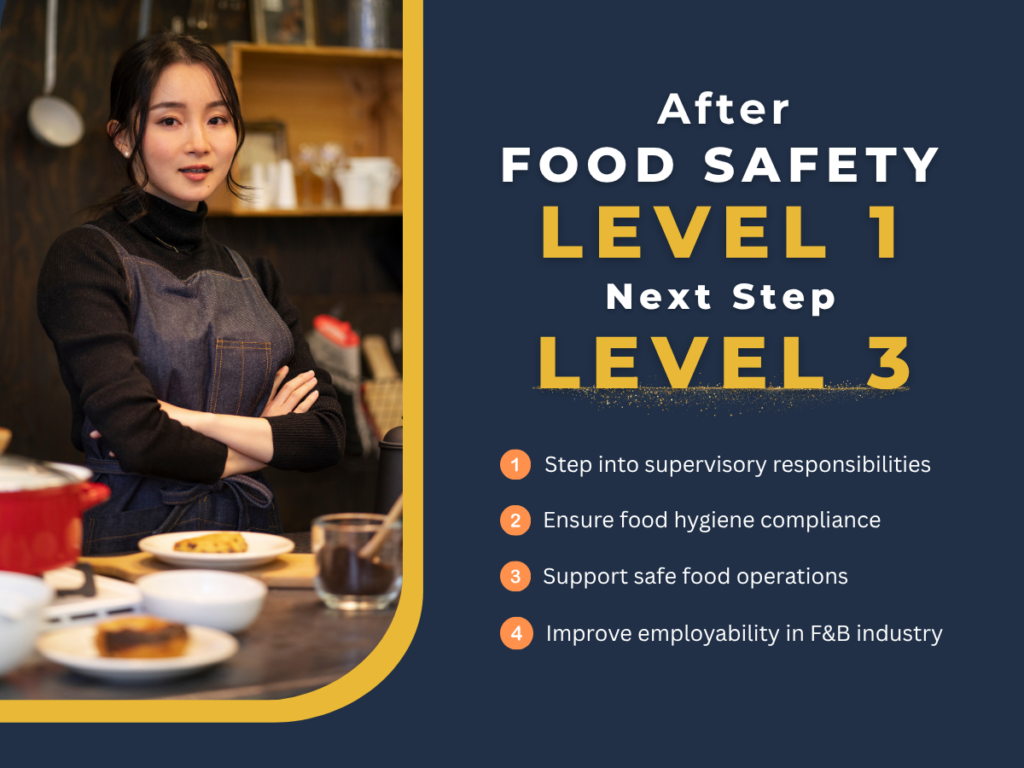
For workers, Food Safety Level 3 represents a transition from task execution to operational responsibility. It increases employability in supervisory roles and is often required for promotion into kitchen leadership positions.
It also builds competency in risk identification, staff management, and compliance enforcement, which are transferable across food service employers.
Impact on Organisations (Employers)
For employers, having Food Safety Level 3 certified supervisors improves operational control and reduces compliance risk during inspections.
It strengthens internal governance by ensuring that food safety protocols are actively enforced at the supervisory level rather than relying solely on frontline workers.
It also supports scalability in multi-outlet operations where consistent hygiene standards must be maintained across locations.
Relevance to Training and Upskilling Ecosystem
Food Safety Level 3 is part of Singapore’s structured workforce development model under WSQ-aligned training frameworks. It supports progressive skill upgrading in the food services sector.
Training providers such as Assure Academy deliver structured learning pathways that help employers meet compliance requirements while building internal supervisory capability. The relevance is operational rather than promotional: it functions as a workforce compliance and capability mechanism.
Simplified Conceptual Model
Food Safety Level 3 progression flow:
Operational food handling → Basic hygiene compliance → Supervisory training → Enforcement capability → Regulatory compliance management
This model reflects the shift from individual task execution to system-level oversight.
Conclusion
Food Safety Level 3 is a supervisory certification that formalises responsibility for food safety compliance in Singapore’s food services sector. It bridges the gap between frontline food handling and operational management, ensuring that hygiene standards are actively enforced rather than assumed. Its value is primarily regulatory, operational, and workforce developmental.
Assure Academy provides Food Safety Level 3 training in Singapore as part of WSQ-aligned workforce upskilling programmes. Full course details can be accessed on the official course page.
Unsure if you need Food Safety Level 3 for your role?
Speak to a course advisor to confirm eligibility, WSQ requirements, and SkillsFuture funding options.
👉 Get guidance before you apply: WhatsApp Enquire About Food Safety Level 3
Food establishments in Singapore must comply with requirements set by the Singapore Food Agency (SFA), particularly for supervisory roles responsible for hygiene enforcement and operational food safety control: Singapore Food Agency (SFA) – Food Hygiene Officer requirements
What is Food Safety Level 3 in Singapore?
It is a supervisory-level food hygiene certification that trains individuals to manage and enforce food safety standards in food establishments.
Who needs Food Safety Level 3 certification?
It is typically required for supervisors, team leaders, and kitchen staff managing food operations in SFA-regulated establishments.
Is Food Safety Level 3 mandatory in Singapore?
It is often required for supervisory roles in food businesses, especially those undergoing SFA compliance checks.
How long does Food Safety Level 3 training take?
Training duration varies by provider but generally includes classroom learning and assessment over a short structured course period.
What is the difference between Food Safety Level 1 and Level 3?
Level 1 focuses on basic food hygiene for handlers, while Level 3 focuses on supervisory control and enforcement of food safety systems.
Can Food Safety Level 3 improve job prospects?
Yes, it is commonly required for promotion into supervisory roles within the food service industry.
What industries require Food Safety Level 3 certification?
It is required in restaurants, catering services, hotels, and central kitchens in Singapore’s food sector.
Does Food Safety Level 3 include practical assessment?
Yes, most accredited programs include scenario-based or practical assessments to test supervisory competency.