
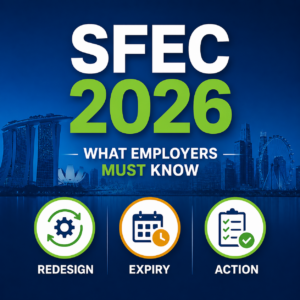
SFEC is changing in 2026

SkillsFuture Enterprise Credit (SFEC) 2026 Update in Singapore: What Employers Need to Know

Executive Summary

The SkillsFuture Enterprise Credit (SFEC) is a Singapore government initiative designed to help employers offset the cost of workforce transformation and training.

Under the SFEC 2026 update framework:

  • Eligible employers can receive up to $10,000 in credit
  • Credits are used to offset approved workforce training costs
  • The scheme supports business transformation, including digitalisation and AI adoption
  • Employers are encouraged to utilise credits before the scheme expiry timeline

SFEC is employer-focused and differs from individual SkillsFuture Credit schemes. It is commonly used for upgrading workforce capabilities in areas such as AI training, digital transformation, compliance, and productivity improvement.

What is the SkillsFuture Enterprise Credit (SFEC)?

The SkillsFuture Enterprise Credit (SFEC) is a government-supported credit scheme administered under Singapore’s workforce development framework.

It is designed to encourage employers to invest in employee training and business transformation initiatives.

SFEC allows eligible employers to offset a portion of training-related expenses using government-provided credits, reducing the cost of workforce upgrading.

Key characteristics:

  • Employer-based credit system
  • Supports workforce transformation initiatives
  • Applies to approved training programmes and courses
  • Administered under national workforce development policies

SFEC 2026 Update Overview

The SFEC 2026 update reflects refinements to the scheme structure, eligibility alignment, and usage framework.

Key updates include:

  • Continued emphasis on workforce transformation outcomes
  • Stronger alignment with digitalisation and AI-related training
  • Clearer guidelines on eligible training usage
  • Defined expiry and utilisation timeline for credits
YearUpdate
2020SFEC introduced to support employer training
2023Refinements to eligibility and usage framework
2026Updated alignment with workforce transformation priorities

Employers should review their remaining credit balance and plan usage strategically before expiry deadlines.

SFEC Eligibility Criteria

To qualify for SFEC, employers must generally meet the following conditions:

  • Registered business entity in Singapore
  • Active CPF contributions for employees
  • Engagement in eligible workforce training activities
  • Participation in approved training programmes


Eligibility Checklist

  • Registered employer in Singapore
  • Meets CPF contribution requirements
  • Engages employees in approved training programmes
  • Uses training for workforce development purposes


Eligibility is automatically assessed through government systems when claims are submitted.

How Employers Use SFEC

Employers can use SFEC credits through a structured process:

Step 1: Identify eligible training needs

Determine workforce skills gaps and training priorities.

Step 2: Select approved training provider

Choose a registered training provider offering eligible courses.

Step 3: Enrol employees

Register employees for selected training programmes.

Step 4: Submit claim

Submit SFEC claim through the designated government portal.

Step 5: Offset training costs

Approved credits are used to offset qualifying training expenses.

This process reduces direct training expenditure while supporting workforce capability building.

What Can SFEC Be Used For?

SFEC supports a wide range of workforce development programmes.

1. Digital Transformation Training

  • Artificial Intelligence (AI) training
  • Generative AI (GenAI) workshops
  • Data analytics and automation training

2. Workplace Compliance Training

  • Workplace safety programmes
  • Regulatory compliance training
  • Industry certification courses

3. Productivity and Skills Upgrading

  • Digital tools adoption
  • Workflow optimisation
  • Operational efficiency training


AI and digital transformation training has become a key focus area under current workforce development priorities.

SFEC vs SkillsFuture Credit

SFEC is often confused with individual SkillsFuture Credit schemes. However, they serve different purposes.

SchemeTarget UserPurpose
SFECEmployersWorkforce training and business transformation
SkillsFuture CreditIndividualsPersonal skills development

Key distinction:
SFEC is designed for company-level training investment, while SkillsFuture Credit supports individual learning.

Why SFEC Matters for Employers in 2026

SFEC remains a critical tool for employers planning workforce transformation.

Key reasons:

  • Reduces cost of employee training
  • Supports adoption of AI and digital technologies
  • Aligns with national workforce upgrading initiatives
  • Encourages long-term skills development strategy


Employers who delay utilisation risk underusing available credits before expiry timelines.

Strategic Recommendation for Employers

Employers should treat SFEC as a strategic workforce development resource rather than a passive subsidy.

Recommended approach:

  • Prioritise high-impact training areas such as AI, automation, and digital skills
  • Align training usage with business transformation objectives
  • Plan utilisation before expiry to avoid unused credits


SFEC is most effective when integrated into long-term workforce planning rather than used reactively.

Enquire About SFEC-Eligible Training Programmes

Assure Academy provides structured training programmes that may align with SFEC-supported workforce development initiatives, including digital transformation and AI-related training.

Employers can evaluate suitable training pathways based on organisational needs and eligibility criteria.

What is the SkillsFuture Enterprise Credit (SFEC)?

The SkillsFuture Enterprise Credit (SFEC) is a Singapore government scheme that provides eligible employers with a one-time $10,000 credit to offset workforce transformation and training costs.

It supports:

  • Employee training
  • Digital transformation
  • Productivity improvement initiatives
  • Enterprise capability upgrading

What is new in the SFEC 2026 update?

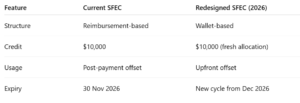
The 2026 update introduces a transition framework:

  • Current SFEC remains usable until 30 November 2026
  • A redesigned SFEC will launch on 1 December 2026
  • Eligible employers will receive a fresh $10,000 credit in a digital wallet
  • The redesigned system allows upfront offset instead of reimbursement-style flow

This marks a structural shift from the existing model to a more digitalised funding system

When does the current SFEC expire?

The current SFEC will expire on:

30 November 2026

After this date:

  • No further use of the current credit is allowed
  • Any unused balance will no longer be valid
  • Employers must transition to the redesigned SFEC system

Will unused SFEC credits be carried over to the new scheme?

No.

Unused credits under the current SFEC:

  • Will expire permanently after 30 November 2026
  • Will not be transferred into the redesigned SFEC system

This is a key policy point for employers planning training budgets.

What is the redesigned SFEC (from Dec 2026)?

The redesigned SFEC will:

  • Provide a fresh $10,000 credit per eligible company
  • Use an online wallet system
  • Allow direct offset at point of enrolment
  • Be integrated under the Enterprise Workforce Transformation Package (EWTP)

This improves cash flow efficiency for employers compared to the current reimbursement-style structure

Who is eligible for SFEC?

Eligibility is typically based on employer criteria such as:

  • Registered business entity in Singapore
  • At least 3 local employees (Singapore Citizens or PRs)
  • Active CPF contribution history
  • Meeting workforce development qualification conditions

Eligible companies are usually notified automatically and do not need to apply separately.

What can SFEC be used for?

SFEC supports both workforce and enterprise transformation.

Workforce training:

  • AI and Generative AI training
  • Digital skills programmes
  • Leadership and supervisory courses
  • Technical upskilling programmes

Enterprise transformation:

  • Digitalisation initiatives
  • Productivity system upgrades
  • Process improvement consulting
  • Technology adoption projects

Can SFEC be used for AI or GenAI training?

Yes.

AI-related training is commonly included under:

  • Digital transformation
  • Productivity enhancement
  • Workforce upskilling initiatives

This includes:

  • Generative AI training
  • Automation tools training
  • Data and analytics programmes

AI training is increasingly a priority area under workforce transformation policy direction.

What happens if employers do not use SFEC before expiry?

If SFEC is not used before 30 November 2026:

  • Remaining credit is forfeited
  • No rollover is permitted
  • Employers lose access to that funding cycle permanently

This creates a strong incentive for early utilisation.

How do employers claim SFEC?

The process generally involves:

  1. Enrol in eligible programme or initiative
  2. Complete training or project activity
  3. Submit claims through relevant government systems
  4. Receive disbursement or offset via approved channels

Depending on programme type, claims may be processed through SkillsFuture for Business or related grant systems.

What is the difference between current SFEC and redesigned SFEC?
Why is SFEC important for employers in 2026?

SFEC remains important because it:

  • Reduces training cost burden
  • Supports workforce transformation
  • Encourages adoption of AI and digital skills
  • Helps SMEs and enterprises scale capability efficiently

The 2026 transition also makes timing critical due to expiry constraints.

Share the Post