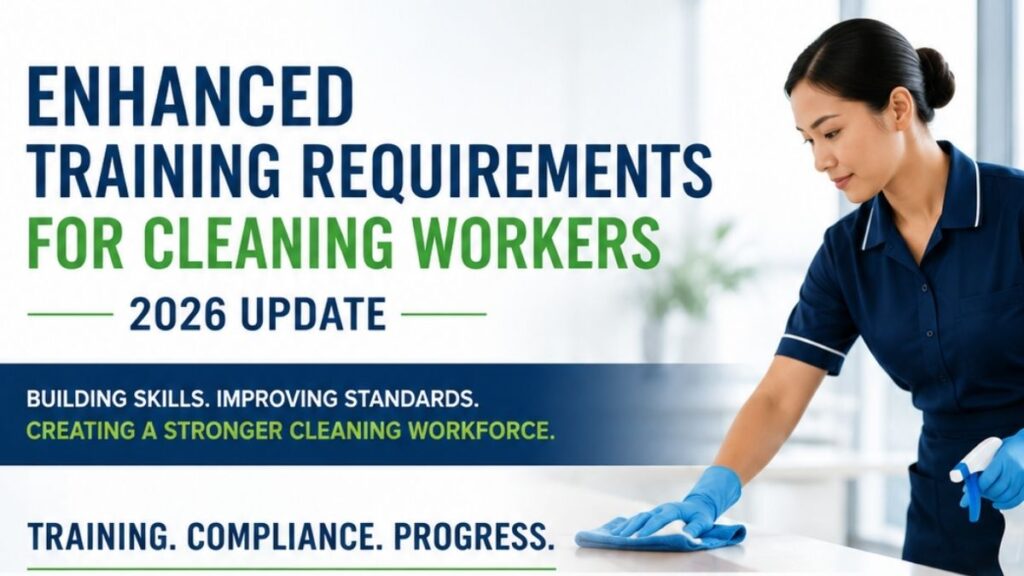
Enhanced Training Requirements for Cleaning Workers in Singapore (2026 Update): What Employers Need to Know
Singapore’s cleaning sector continues to undergo structured transformation through policy-driven workforce upgrading. The 2026 update to training requirements reinforces the government’s direction to improve productivity, standardise skills, and strengthen compliance within the industry.
Under the 2026 Addendum issued by the Tripartite Cluster for Cleaners and aligned with the Ministry of Manpower, training requirements under the Progressive Wage Model (PWM) have been refined and expanded.
For employers, this is not a minor adjustment. Training is now more explicitly tied to licensing, workforce planning, and operational continuity.
What is the 2026 TCC Addendum?
The 2026 TCC Addendum is a policy update that strengthens existing training requirements for cleaning workers under the PWM framework.
It focuses on:
- Standardising Workforce Skills Qualifications (WSQ) requirements
- Aligning training with job roles and progression levels
- Reinforcing training as a mandatory licensing condition
- Supporting long-term industry transformation
This update builds on earlier enhancements introduced from 2022 and continues a phased regulatory approach.
Key Definitions (For Employers and HR Teams)
Progressive Wage Model (PWM)
A structured framework that links wages to skills, productivity, and job responsibilities. Workers must meet training requirements to progress within the wage ladder.
Workforce Skills Qualifications (WSQ)
Singapore’s national credential system that certifies workforce competencies across industries.
Tripartite Cluster for Cleaners (TCC)
The body responsible for setting standards for wages, training, and productivity in the cleaning sector.
Enhanced Training Requirements Under PWM (2026)
Cleaning businesses are required to ensure that all workers meet mandatory WSQ training requirements based on their job roles.
Core Requirement Structure
Each cleaning worker must complete:
- 1 Workplace Safety and Health (WSH) module (mandatory)
- 2 to 3 Core WSQ modules, depending on job level
This ensures both safety compliance and skills competency.
Training Requirements by Job Level
| PWM Job Level | Total Modules Required | WSH Module | Core Modules | Training Depth | Employer Implication |
|---|---|---|---|---|---|
| Lower Job Levels | 3 modules | Mandatory | 2 modules | Foundational | Entry-level compliance, basic workforce readiness |
| Higher Job Levels | 4 modules | Mandatory | 3 modules | Advanced | Increased training cost and structured workforce planning |
What Changed from Previous Framework?
| Aspect | Pre-2026 Framework | 2026 TCC Addendum |
|---|---|---|
| Training Structure | General WSQ requirement | Clearly structured by job level |
| Number of Modules | Less defined | Standardised (3–4 modules) |
| WSH Requirement | Mandatory | Remains unchanged |
| Skills Progression | Present | Stronger alignment to PWM ladder |
| Licensing Requirement | Required | Strict enforcement condition |
| Implementation | Phased (from 2022) | Continued enhancement beyond 2025 |
Implementation Timeline
| Phase | Timeline | Description | Employer Action |
|---|---|---|---|
| Initial Enhancement Phase | From 31 Dec 2022 | Initial strengthened WSQ requirements introduced | Begin aligning training systems |
| Addendum Review Phase | 2026 | TCC updates and clarifies training framework | Adjust internal training structure |
| Proposed Implementation | 1 July 2027 (recommended) | Industry-recommended ETR implementation date | Prepare full compliance readiness |
Who is Affected?
The requirements apply to:
- Licensed cleaning companies in Singapore
- In-house cleaning teams under PWM coverage
- All cleaners across job levels
- Singapore Citizens, Permanent Residents, and applicable foreign workers
Training compliance is directly tied to business licensing conditions.
Operational Impact on Employers
1. Workforce Planning
Training must be scheduled around operational demands, requiring better manpower allocation.
2. Cost Management
Higher job roles require additional modules, increasing training investment per worker.
3. Compliance Risk
Failure to meet requirements may affect licence renewal and trigger enforcement actions.
4. Productivity Alignment
Structured training supports adoption of mechanised and technology-enabled cleaning solutions.
Consequences of Non-Compliance
While the TCC Addendum focuses on enhanced training requirements, compliance is enforced under broader regulatory frameworks governed by the Ministry of Manpower and the National Environment Agency.
Employers who fail to meet Progressive Wage Model (PWM) requirements, including mandatory training, may face:
- Regulatory enforcement actions by MOM for PWM non-compliance
- Impact on Cleaning Business Licence (CBL) status, including possible suspension or non-renewal
- Financial penalties under applicable legislation and licensing conditions
- Increased likelihood of inspections or compliance audits
Training compliance is therefore a regulatory requirement tied to both employment and licensing obligations, not an optional enhancement.
When will the enhanced training requirements take effect?
In consultation with industry stakeholders, the Tripartite Cluster for Cleaners (TCC) recommends that the Enhanced Training Requirements (ETR) take effect from 1 July 2027.
This provides employers with a transition period to:
- adjust workforce training schedules
- align WSQ module completion pathways
- integrate updated compliance requirements into licensing processes
The recommendation reflects a phased implementation approach to support industry readiness.
Key Takeaway
The 2026 TCC Addendum strengthens Singapore’s Progressive Wage Model by standardising WSQ training requirements across job levels in the cleaning sector.
Employers must ensure workers complete 3 to 4 training modules, including Workplace Safety and Health training, with compliance directly linked to licensing, workforce capability, and operational continuity.
Is PWM training mandatory for cleaning workers in Singapore?
Yes. Training is a compulsory requirement under the PWM framework and is tied to licensing compliance.
How many training modules are required under the 2026 update?
Workers must complete 3 to 4 WSQ modules, including one mandatory WSH module.
Can employers complete training progressively?
Yes. Training can be scheduled in phases, but must meet the compliance timeline.
Do foreign workers need to meet the same requirements?
Yes, where applicable under the licensing framework, the same training standards apply.
Does this apply to in-house cleaners?
Yes. In-house cleaning teams under PWM coverage must comply with the same training requirements.